

When students plan to study in India or abroad, one of the biggest questions is:
“Which education loan is better – IDFC First Bank vs Tata Capital education loan?”
Both are popular private lenders and offer high loan amounts, flexible tenures and quick processing. But there are clear differences in interest rates, secured vs unsecured limits, processing fees, and EMI burden. In this blog, we will compare:
- Interest rates
- Loan amount & security (collateral)
- Tenure & moratorium
- Fees & charges
- Eligibility & documents
- EMI comparison with simple calculations
So that by the end, you can decide which lender fits your study plans better.
Note: All numbers are based on latest public information from official and trusted sites as of 2024–2025. Always recheck final rates before applying.
Basic Overview: IDFC First Bank vs Tata Capital Education Loan
IDFC First Bank – Education Loan Overview
- Interest rate: Starts from about 9.5% p.a. (secured; unsecured higher)
- Type: Loans for India and abroad
- Maximum loan amount:
- Up to ₹2 crore overall
- Up to ₹2 crore overall
- Collateral-free (unsecured): Up to around ₹75 lakh–₹1 crore (depends on profile & country)
- Tenure: Up to 12–15 years
- Special features:
- Doorstep service
- Section 80E tax benefits
- Balance transfer option with up to 2% lower interest for existing loans
- Doorstep service
Tata Capital – Education Loan Overview
- Interest rate: Roughly 9.5% to 18% overall; for many abroad cases usually 10.99%+
- Maximum loan amount:
- Up to ₹2 crore (secured)
- Up to ₹85 lakh (unsecured)
- Up to ₹2 crore (secured)
- Tenure: Up to 13 years
- Special features:
- Simple online process
- Category-based limits for US / non-US universities for abroad loans
- Simple online process
Quick Summary
- If you want lower starting interest rates and longer tenure, IDFC First Bank usually looks slightly better.
- If you want a known NBFC brand and flexible category-based funding, Tata Capital is also a strong option.
Interest Rate Comparison
Interest rate is the biggest factor because even a small difference (1–2%) changes your EMI and total interest a lot.
IDFC First Bank – Interest Rates
- Education loan interest rate starts from 9.5% p.a.
- For secured loans: often closer to 9.5%–10%.
- For unsecured loans (especially abroad): often around 11%–12.25%+, depending on country & category.
Tata Capital – Interest Rates
- Official range is 9.5% to 18% p.a.
- Many student-focused sources show starting from about 10.99%–11.5% for abroad education loans.
Who is cheaper on interest?
- On paper, IDFC First Bank’s starting 9.5% is usually lower than most Tata Capital slabs.
- In real approvals, your rate depends on:
- Course & college
- Secured or unsecured
- Co-applicant income and credit score
- Course & college
In many typical cases, IDFC First Bank tends to offer a slightly lower interest rate than Tata Capital for similar profiles.
Loan Amount & Collateral: Who Offers More?
IDFC First Bank
- Maximum loan: Up to ₹2 crore (secured)
- Unsecured (no collateral): Up to around ₹75 lakh–₹1 crore depending on category and country.
Tata Capital
- Maximum loan:
- Up to ₹2 crore secured
- Up to ₹2 crore secured
- Unsecured (no collateral): Up to ₹85 lakh
Who is better for high amounts?
- Both go up to ₹2 crore with security.
- For unsecured, Tata Capital clearly mentions ₹85 lakh, while IDFC often goes up to ₹75 lakh–₹1 crore depending on category.
- If you want a very large unsecured loan for abroad (say ₹80 lakh+), Tata Capital may be slightly more transparent in limits, but in practice both can support big tickets if your profile is strong.
Tenure, Moratorium & Repayment Flexibility
IDFC First Bank
- Tenure: Up to 12–15 years
- Moratorium: Course duration + generally 12 months after course completion.
- Repayment: Flexible EMIs; balance transfer available.
Tata Capital
- Tenure: Up to 13 years
- Moratorium: Varies by product, usually you start repayment after course or partial payment during course; details in sanction.
Verdict
- Both give long tenures.
- If you want very long repayment (15 years), IDFC First Bank may give a bit more breathing space.
- Moratorium conditions must be checked in your specific sanction letter for both lenders.
Fees & Other Charges
IDFC First Bank
- Processing fee is usually around 1% of the loan amount for many programs, but can vary.
- Balance transfer facility may also involve small charges.
Tata Capital
- Processing fee is about 1% + GST for education loans in many abroad products.
Overall, processing fees are similar (around 1% for both). Check:
- Late payment charges
- Prepayment / foreclosure charges (often flexible but must be confirmed).
Eligibility & Documents – Basic Idea
Common Eligibility Points
Both lenders typically require:
- Indian citizen
- Age usually 18+ at the time of application
- Confirmed admission to a recognized institution in India or abroad
- Co-applicant (parent/spouse/guardian) with stable income for most unsecured cases
For example, IDFC First clearly mentions Indian resident, 18+, admission proof, co-applicant documents etc.
Documents usually include:
- Student KYC, academic records, admission letter, fee structure
- Co-applicant KYC and income proof
- Collateral papers (if secured loan)
In practice, document requirements are very similar for both IDFC First Bank and Tata Capital.
EMI Comparison with Simple Calculations
Let’s take a practical example so you can “feel” the difference between the two.
Example 1: ₹20 lakh loan for 10 years
Assume:
- Loan amount = ₹20,00,000
- Tenure = 10 years = 120 months
We compare two possible scenarios:
- IDFC First Bank at 10% p.a.
- Tata Capital at 12% p.a.
These rates are only for example, actual rates will depend on your profile.
Step 1 – Convert interest rate to monthly
- 10% p.a. → 10 / 12 = 0.833% per month
- 12% p.a. → 12 / 12 = 1.0% per month
Step 2 – EMI Formula
EMI formula is:
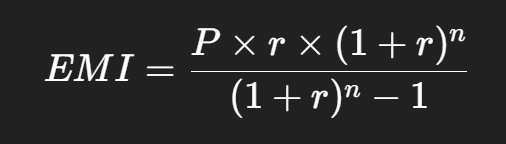
Where:
- P = loan amount
- r = monthly interest rate
- n = total number of months
You don’t need to calculate manually in real life; banks have EMI calculators. We will use rounded values here.
Approximate EMI – IDFC First Bank at 10%
For ₹20 lakh, 10 years, 10% p.a.:
- Approx EMI ≈ ₹26,430 per month
Total paid in 10 years = ₹26,430 × 120 ≈ ₹31,71,600
Total interest ≈ ₹31,71,600 − ₹20,00,000 = ₹11,71,600
Approximate EMI – Tata Capital at 12%
For ₹20 lakh, 10 years, 12% p.a.:
- Approx EMI ≈ ₹28,687 per month
Total paid in 10 years = ₹28,687 × 120 ≈ ₹34,42,440
Total interest ≈ ₹34,42,440 − ₹20,00,000 = ₹14,42,440
What does this example show?
- EMI with IDFC (10%) ≈ ₹26.4k
- EMI with Tata Capital (12%) ≈ ₹28.7k
Difference in EMI ≈ ₹2,250 per month
Over 10 years, total extra interest with higher rate ≈ ₹2.7 lakh.
So, a 2% increase in interest can cost you lakhs of rupees over long tenure.
This is why even a small rate advantage from IDFC First Bank (or any lender) becomes very important.
Which Lender is Better for You?
Here is a simple comparison to help you decide.
Choose IDFC First Bank Education Loan if
- You are getting a lower interest rate (for example 9.5%–10.5%)
- You need a long tenure (up to 15 years) for lower monthly EMIs
- You want flexible repayment and a chance to do a balance transfer from another bank
- Your college / course fits their preferred categories with better slabs
Choose Tata Capital Education Loan if
- You are comfortable with interest rates starting around 10.99%+, but are getting good service and quick approval
- You need clear unsecured limits up to ₹85 lakh for abroad studies
- You want a NBFC lender with flexible products and are okay comparing multiple offers
Tips to Decide Between IDFC First Bank and Tata Capital
Regardless of lender, follow these steps:
1. Collect Sanction Letters from Both
- Apply (or at least get offers) from both lenders.
- Compare:
- Final interest rate
- Whether loan is secured / unsecured
- EMI amount & tenure
- Moratorium terms (do you pay simple interest during course or full EMI later?)
2. Use Online EMI Calculators
Both IDFC First Bank and Tata Capital provide online EMI calculators to quickly check monthly EMI.
Try:
- Loan: ₹30 lakh
- Tenure: 10–15 years
- Different interest rates (e.g., 10%, 11.5%, 12%)
See how EMI changes and choose a plan your family can safely afford.
3. Check Total Cost, Not Just EMI
A lower EMI with very long tenure may look attractive, but you might pay more total interest.
For example:
- ₹20 lakh at 11% for 10 years vs 15 years – 15 years EMI is smaller, but total interest will be much higher.
- So balance between monthly comfort and total interest cost.
4. Look at Service and Speed
- Talk to students or counsellors who have actually taken IDFC First Bank or Tata Capital loans.
- Ask:
- How fast was disbursement?
- Was communication clear?
- Any hidden charges or surprises?
Sometimes a lender with slightly higher rate but smooth service may be better than a lower-rate lender with delays and confusion.
Final Conclusion – IDFC First Bank vs Tata Capital Education Loan
Both IDFC First Bank and Tata Capital are strong options for education loans in India and abroad. In simple terms:
- IDFC First Bank generally wins on:
- Lower starting interest rates
- Longer tenure
- Good balance transfer options
- Tata Capital is attractive for:
- Clear unsecured limits up to ₹85 lakh
- Flexible NBFC-style offerings and wide coverage of universities
If your main focus is lowest possible EMI and interest, IDFC First Bank will often be slightly better.
If you want fast approval with a high unsecured amount for abroad, Tata Capital also deserves a close look.