

If you own a car in the United States, you have probably heard the name GEICO many times. You might have seen TV ads, online banners, or funny characters talking about saving money on car insurance. But what exactly is GEICO? How does it work? And can it really help you save money on your car insurance?
In this easy-to-understand blog, we will explain:
- What GEICO is
- The main services and types of insurance it offers
- Important features and benefits for customers
- Types of car insurance coverages
- Discounts and ways to save money
- Examples and simple calculations of possible savings
- Tips to choose and manage a GEICO policy wisely
This guide is written in simple language so that even a beginner can understand car insurance concepts clearly.
What Is GEICO?
GEICO is one of the largest auto insurance companies in the United States. It offers car insurance to millions of drivers across the country. Over time, it has grown from a small company focused on government employees to a major insurance provider for all kinds of drivers.
Today, GEICO:
- Provides auto insurance in all 50 U.S. states and the District of Columbia
- Offers other insurance products through partners (for example, home, renters, and more)
- Is known for competitive prices, many discounts, and easy digital tools for customers
Because of its size and experience, GEICO can often offer good coverage at a price that works for many customers.
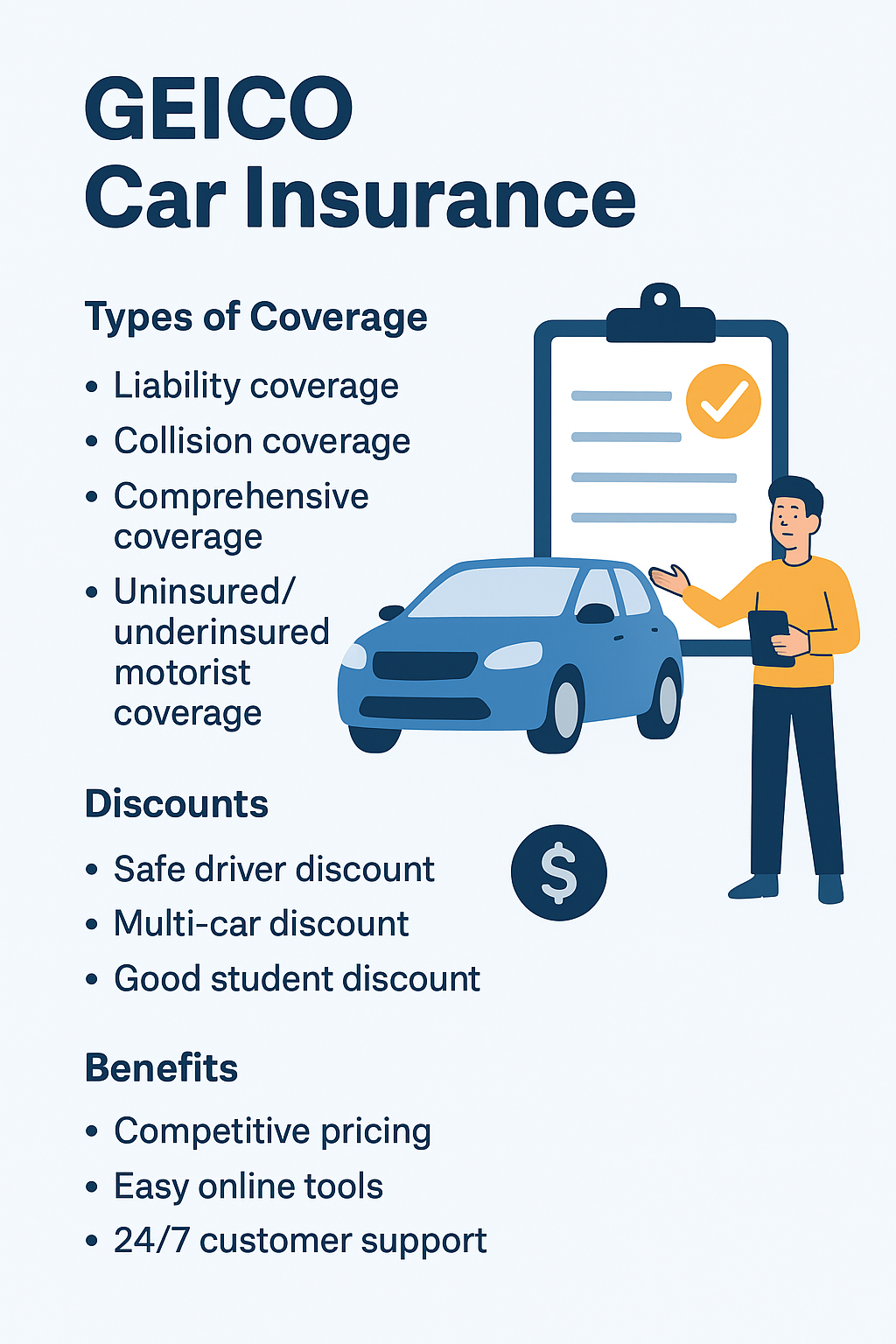
Key Services and Insurance Products
Even though GEICO is best known for car insurance, it also provides or helps you connect with many other insurance products. These include:
- Auto insurance (personal cars)
- Motorcycle and scooter insurance
- RV (recreational vehicle) insurance
- Boat insurance
- Commercial auto insurance (for business vehicles)
- Rideshare coverage (for drivers using ride-hailing platforms, in some areas)
- Property-related insurance through partners, such as:
- Homeowners
- Renters
- Condo
- Mobile home
This means that many customers can manage several types of insurance in one place, which is convenient and sometimes helps with extra discounts.
Why Many Drivers Choose GEICO
People choose GEICO for many reasons. Here are some of the most important benefits that attract customers:
1. Competitive Pricing
One of the biggest reasons people look at GEICO is the chance to save money on premiums. The company is known for:
- Offering competitive rates compared to many other insurers
- Providing many types of discounts (safe driver, multi-car, etc.)
- Allowing you to customize coverage to match your budget
We will see some example calculations a little later in this blog.
2. Easy Online and App Experience
GEICO invests a lot in online services and mobile apps. This helps customers to:
- Get a quote in a few minutes
- Buy a policy online
- View ID cards on their phone
- File and track claims through the app or website
- Pay bills and manage policy changes anytime
For busy people, this is a big advantage because they do not need to visit an office or call support for everything.
3. 24/7 Customer Support
GEICO offers 24/7 customer service and claims reporting. This is helpful because accidents do not only happen during office hours. You can reach out at any time to:
- Report an accident
- Ask questions about your coverage
- Check claim status
4. Wide Availability
GEICO serves drivers across the United States. This makes it easier for people who move from one state to another, because they can often keep their insurance with the same company (with updated state rules and rates).
Main Types of Auto Insurance Coverage with GEICO
When you buy car insurance from GEICO, you can choose from several types of coverage. Each type protects you in different situations. Let’s go through the main ones in simple terms.
1. Liability Coverage
This is usually required by law in most states.
- Bodily Injury Liability: Pays for injuries to other people if you are at fault in an accident.
- Property Damage Liability: Pays for damage you cause to someone else’s car or property.
Example:
If you accidentally hit another car and the repair cost is $5,000 and the driver’s medical bills are $7,000, liability coverage helps pay these costs (up to your policy limit).
2. Collision Coverage
- Pays to repair or replace your car if it is damaged in an accident, no matter who was at fault.
Example:
Your car hits a tree and repair costs are $4,000. If you have collision coverage and a deductible of $500, the insurance may pay $3,500 and you pay $500.
3. Comprehensive Coverage
- Covers damage to your car from non-accident events such as theft, fire, vandalism, falling objects, or certain weather events.
Example:
A big branch falls on your parked car and causes $2,000 in damage. With comprehensive coverage and a $250 deductible, the insurer might pay $1,750 and you pay $250.
4. Uninsured/Underinsured Motorist Coverage
- Protects you if another driver causes an accident but has no insurance or not enough insurance.
Example:
Another driver hits your car and is at fault but has no insurance. This coverage helps pay for your medical bills and sometimes damage to your vehicle, depending on state rules and policy options.
5. Medical Payments or Personal Injury Protection (PIP)
- Helps pay for medical expenses for you and your passengers after an accident, sometimes regardless of fault (depending on the state).
6. Additional Options
Depending on where you live and your policy, there may be:
- Rental reimbursement (pays for a rental car while yours is being repaired after a covered claim)
- Emergency roadside service (towing, flat tire change, jump-start, etc.)
- Mechanical breakdown coverage for newer cars in some cases
These add-ons can make your policy more helpful and convenient.
Discounts and Offers to Help You Save
One of the biggest ways GEICO attracts customers is through a wide range of discounts. While the exact amounts and availability can vary by state and situation, some common discount categories include:
- Safe driver discount – For drivers with a clean driving record for a certain number of years
- Multi-car discount – Insuring more than one vehicle on the same policy
- Multi-policy / bundling – Having car insurance plus other types like homeowners or renters through their network
- Good student discount – For students with good grades (for example, B average or better)
- Defensive driving course discount – Completing an approved safety or defensive driving class
- Vehicle safety features discount – Cars with airbags, anti-lock brakes, anti-theft systems, etc.
- Military and federal employee discounts – For certain groups with eligible status
Not every discount is available to every person, but combining just a few can lead to strong savings.
Example: How Discounts Can Change Your Premium
Let’s look at a simple sample calculation to understand how savings might look.
(Note: This is only an example with made-up numbers, not an actual quote.)
Imagine:
- Base yearly premium for your car: $1,800
Now suppose you qualify for these discounts:
- Safe driver discount: 10%
- Multi-car discount (you insure 2 cars): 15%
- Good student discount for your child: 5%
Insurance companies typically apply discounts to the base premium, often one after another (the specific method can vary, but this example shows the idea).
Step 1: Safe driver discount
10% of $1,800 = 0.10 × 1,800 = $180
New premium = 1,800 – 180 = $1,620
Step 2: Multi-car discount
15% of $1,620 = 0.15 × 1,620 = $243
New premium = 1,620 – 243 = $1,377
Step 3: Good student discount
5% of $1,377 = 0.05 × 1,377 = $68.85 (round to $69)
New premium ≈ 1,377 – 69 = $1,308
So, with these three discounts, the yearly premium went from $1,800 to about $1,308, a savings of $492 per year.
This example shows how combining different offers can make a big difference in cost.
Example: Comparing Different Deductibles
A deductible is the amount you agree to pay out of pocket if you have a claim. Higher deductibles usually mean lower premiums, and lower deductibles mean higher premiums.
Let’s say:
- Option A:
- Collision deductible: $500
- Comprehensive deductible: $500
- Yearly premium: $1,400
- Option B:
- Collision deductible: $1,000
- Comprehensive deductible: $1,000
- Yearly premium: $1,200
Difference in yearly premium: $1,400 – $1,200 = $200
So if you choose the higher deductible (Option B), you save $200 per year, but you agree to pay more out of pocket if you have a claim.
For example, if you have an accident causing $3,000 in damage:
- With a $500 deductible, you pay $500 and insurance pays $2,500.
- With a $1,000 deductible, you pay $1,000 and insurance pays $2,000.
You must decide which option fits your budget and comfort level.
Digital Tools and Online Services
Another strong point is the online and mobile experience provided to policyholders. Customers can usually:
- Get a fast quote through the website
- Use a mobile app to:
- View digital ID cards
- Pay bills
- Request changes to the policy (for example, adding a car or driver)
- Report and track claims
- Use online resources to learn about coverage types and insurance terms
For many tech-friendly users, this reduces stress and saves time, because they don’t need to call for every small task.
Claims Handling and Support
When you buy insurance, you’re not only buying a piece of paper—you’re buying support when something goes wrong. GEICO provides:
- 24/7 claim reporting (online, by phone, or through the app)
- Guidance through the repair process
- Access to repair networks and sometimes help with rental cars (if you have that coverage)
While each person’s claim experience can be different, having a big support system and digital tools can make the overall process smoother.
Tips to Get the Most Value from a GEICO Policy
To make sure you get good value, consider the following tips:
1. Compare Quotes
- Always compare quotes from multiple insurers, including GEICO.
- Use the same coverage levels for each quote so you can compare fairly.
2. Choose the Right Coverage Level
- Do not buy the cheapest coverage blindly.
- Make sure liability limits are high enough to protect your money and assets.
- Consider comprehensive and collision for newer or more valuable cars.
- For older cars with low value, sometimes dropping collision or comprehensive may make sense.
3. Ask About All Possible Discounts
- Safe driver
- Multi-car
- Multi-policy
- Good student
- Defensive driving course
- Safety features
Make a list of your situation and ask which discounts you can get.
4. Review Your Policy Every Year
- As your life changes (new car, moving to a new state, marriage, children, etc.), update your policy.
- Check if you still need all add-ons or if you can adjust deductibles.
5. Keep a Clean Driving Record
- Avoid speeding tickets and dangerous driving.
- Fewer accidents and violations often mean lower premiums over time.
Example: Evaluating If a Policy Fits You
Imagine you are a 30-year-old driver with a mid-sized car, driving around 12,000 miles per year. You get the following yearly quote:
- Liability (good limits)
- Collision
- Comprehensive
- Roadside assistance
- Rental reimbursement
Total premium: $1,500 per year
You ask for discounts and find out:
- You qualify for a safe driver and multi-car discount
- You can raise your deductibles slightly
After adjustments, your new premium offer becomes $1,250 per year.
Now ask yourself:
- Can you afford the deductible if an accident happens?
- Are you comfortable with the coverage limits?
- Do the extra services (like roadside assistance) give you peace of mind?
If the answers are yes, this kind of adjusted policy might be a good fit.
Is GEICO Right for You?
GEICO can be a strong option if you:
- Want competitive rates and many discounts
- Like using online tools and apps to manage your policy
- Prefer 24/7 customer support
- Need flexible coverage options that you can adjust based on your budget
However, the best way to know is to:
- Get an actual quote based on your real details.
- Compare it with quotes from other companies.
- Look at both price and coverage, not price alone.
Also Read: Auto Insurance For Students: Complete Guide
Final Thoughts
Choosing car insurance is an important financial decision. GEICO is a major company that offers:
- A wide range of auto insurance coverages
- Many discount options that can lower your premium
- Digital tools to make life easier
- 24/7 customer support and claims assistance
By understanding how its coverages, offers, and discounts work, you can make smarter choices and possibly save hundreds of dollars each year. Always remember to:
- Compare quotes
- Ask about all discounts
- Review your policy regularly
With the right approach, you can use GEICO’s services in a way that gives you good protection and value for your money.